

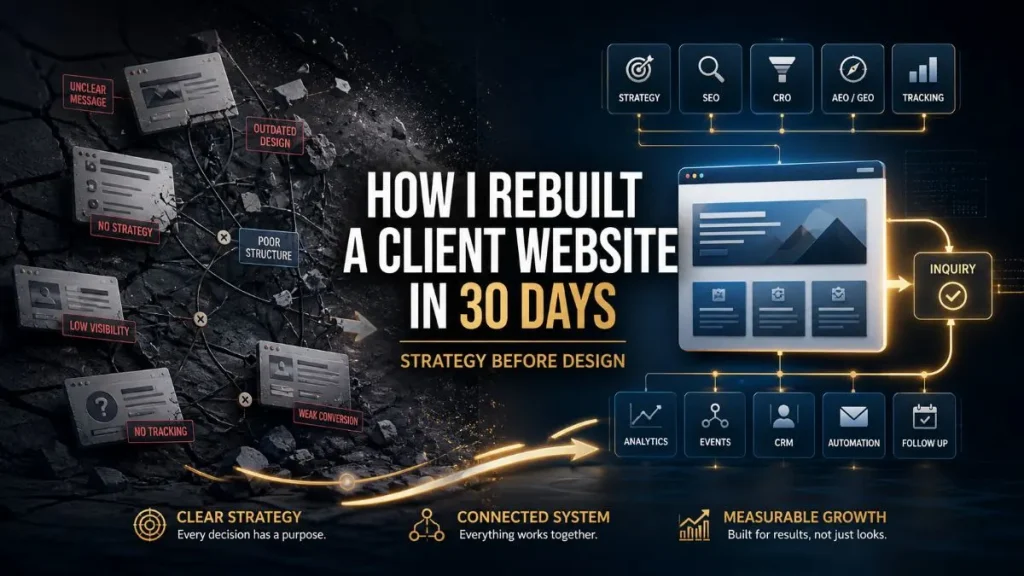
How I rebuilt a client website in 30 days, that’s fast right?
But the important part was not only the timeline.
The important part was the order.
Most website rebuilds start with the question:
“Can we make it look better?”
That question matters, but it should not be the first question.
For this rebuild, the focus was not just design. The focus was strategy, structure, service positioning, SEO, CRO, AEO/GEO, tracking readiness, and the path from visitor to inquiry.
A better website should not only look cleaner.
It should help the right people understand the business faster, trust the offer more clearly, and take the next step with less confusion.
That is the difference between redesigning a website and rebuilding it as part of a growth system.
Table of Contents
Why This Was Not Just a Redesign
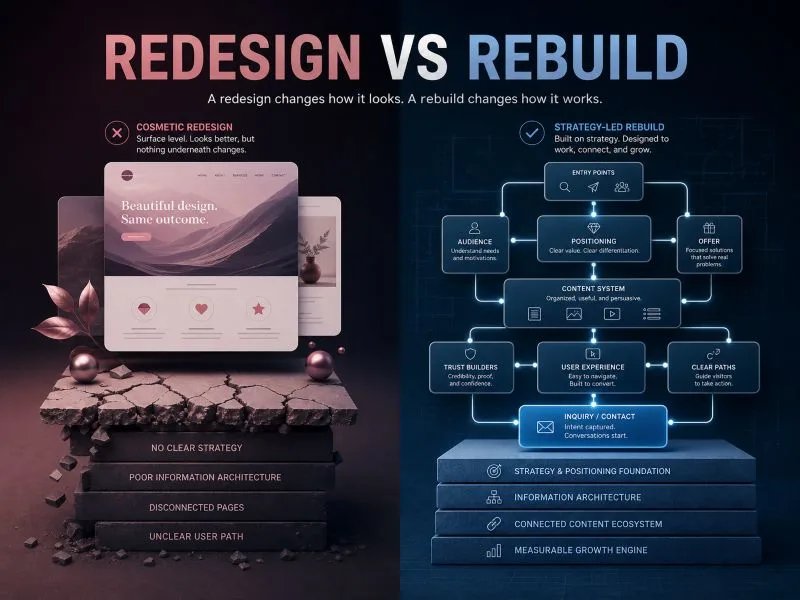
A redesign changes how a website looks.
A rebuild changes how a website works.
That distinction matters.
A website can look modern but still have problems underneath:
| Surface Problem | Deeper System Problem |
|---|---|
| The homepage feels outdated | The offer is not clear enough |
| The service pages look thin | The services are not positioned around buyer intent |
| The CTA feels weak | The visitor journey is unclear |
| The site gets traffic but few inquiries | SEO and CRO are not aligned |
| Leads come in but do not move forward | Follow-up, CRM, or booking logic is disconnected |
| Marketing reports feel vague | Tracking is not connected to meaningful business actions |
For this project, the goal was not to make a prettier website.
The goal was to rebuild the website so it could support a clearer business path:
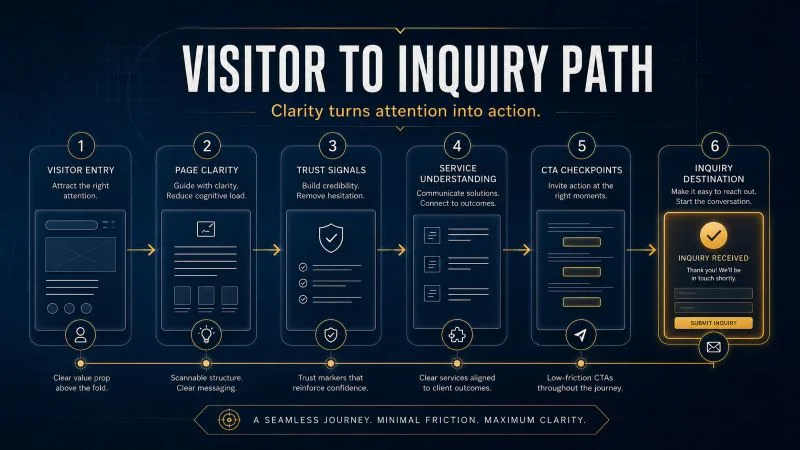
Visitor → understanding → trust → action → inquiry → follow-up
That is why I treated the project as a website growth system rebuild, not a visual refresh.
The Problem With Starting From Design
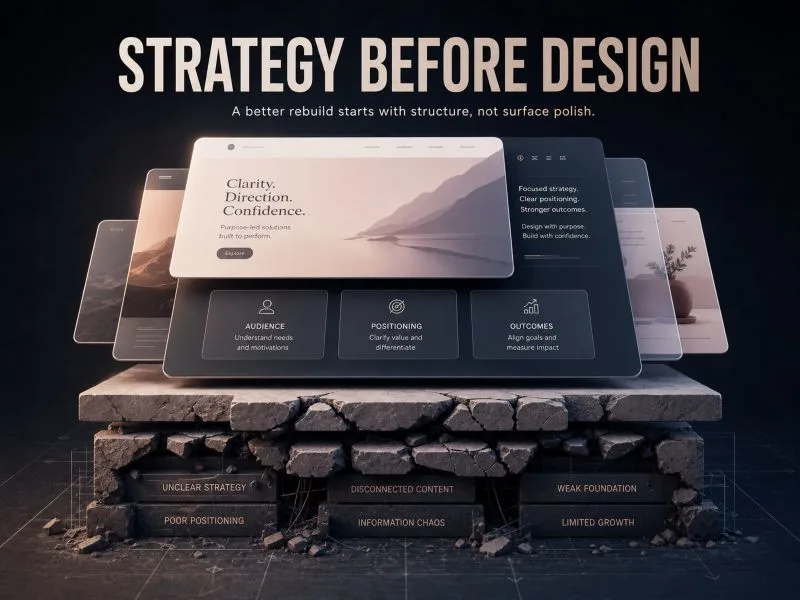
Many website rebuilds go wrong because they start with visuals before strategy.
The project often begins with questions like:
- What colors should we use?
- What should the homepage look like?
- Which template looks better?
- Should we make it more modern?
- What animation should we add?
Those questions are not wrong.
They are just too early.
Before design, a serious rebuild should answer:
| Question | Why It Matters |
|---|---|
| What is the business goal of the website? | The website needs a clear job. |
| Who is the website built for? | Messaging changes depending on the reader. |
| What services need their own pages? | SEO and conversion depend on structure. |
| What does the visitor need to understand before contacting you? | Page flow affects trust. |
| What action should each page drive? | CTAs need to match intent. |
| What should be tracked? | You cannot improve what you cannot measure. |
| What happens after someone submits, calls, or books? | Follow-up determines whether the lead moves forward. |
If those questions are skipped, the new website may look better but still fail in the same places.
That is why this 30-day rebuild started with the system behind the site.
How I Rebuilt a Client Website in 30 Days: The Framework
This is the framework I used to think through the rebuild.
The exact details will vary by business, but the order matters.
Phase 1: Strategy
What Was Reviewed or Improved
The first step was to clarify what the website needed to do for the business.
That included reviewing:
- The main audience
- The primary business goal
- The core services
- The main conversion action
- The role of the homepage
- The role of service pages
- The next step after a visitor becomes interested
Why It Mattered
Without strategy, the website becomes a collection of pages.
With strategy, each page has a job.
The homepage should orient the visitor.
Service pages should explain specific offers.
Supporting content should build trust.
CTAs should guide people toward the next step.
What Business Owners Can Learn
Before rebuilding your website, ask:
“What should this website help the business accomplish?”
If the answer is vague, the rebuild will likely become a design project instead of a business project.
Phase 2: Page Structure
What Was Reviewed or Improved
Next, I looked at how the website should be organized.
This included reviewing:
- Which pages were needed
- Which pages should be removed, merged, or expanded
- How the homepage should guide visitors
- How service pages should be grouped
- How internal links should move people through the site
- Whether the structure supported search intent
Why It Mattered
A website structure affects both SEO and CRO.
If the right pages do not exist, Google has less context.
If visitors cannot find what they need, they leave.
If services are buried, thin, or grouped too broadly, potential clients may not understand the offer clearly enough to inquire.
What Business Owners Can Learn
A website rebuild should not begin in the page builder.
It should begin with the sitemap.
Before designing the page, decide what pages need to exist and what job each page has.
Phase 3: Service Positioning
What Was Reviewed or Improved
The service messaging needed to be clearer.
That meant reviewing:
- How each service was described
- Whether the service matched a real buyer problem
- Whether the copy explained outcomes, process, and fit
- Whether the service pages answered common questions
- Whether the CTA matched the buyer’s stage of awareness
Why It Mattered
Many service business websites list services, but do not position them.
Listing a service tells people what you offer.
Positioning explains why it matters, who it is for, and why someone should take the next step.
What Business Owners Can Learn
A service page should not only say:
“We offer this service.”
It should answer:
- Who is this for?
- What problem does it solve?
- Why does it matter now?
- What makes this approach different?
- What should the visitor do next?
Phase 4: SEO Foundation
What Was Reviewed or Improved
The SEO foundation needed to support the rebuild from the start.
That included reviewing:
- Page titles
- Meta descriptions
- H1 and H2 structure
- Primary keyword focus
- Search intent
- Service page opportunities
- Internal link opportunities
- Local SEO relevance where applicable
Why It Mattered
SEO should not be added after the design is done.
If SEO is treated as an afterthought, you may end up with pages that look good but do not target the right search intent.
For a service business, SEO should connect visibility to conversion.
The goal is not just traffic.
The goal is qualified traffic reaching the right page and taking the right next step.
What Business Owners Can Learn
Plan SEO before layout.
Every important page should have a clear search purpose, target reader, primary keyword theme, and conversion goal.
Phase 5: AEO/GEO Structure
What Was Reviewed or Improved
The site also needed to be easier for answer engines, AI search tools, and local discovery systems to understand.
That meant improving:
- Clear headings
- Answer-friendly sections
- FAQ structure
- Service explanations
- Entity clarity
- Local relevance where applicable
- Internal linking between related topics
Why It Mattered
Search is changing.
People are not only clicking through traditional search results. They are also asking AI tools, scanning summaries, and comparing businesses before ever reaching a website.
A website needs clear information architecture so both people and systems can understand:
- What the business does
- Who it serves
- Where it serves
- What services are offered
- What questions the business can answer
What Business Owners Can Learn
AEO and GEO are not about stuffing keywords.
They are about making your website easier to understand, quote, summarize, and trust.
Phase 6: CRO and Conversion Path
What Was Reviewed or Improved
The rebuild also focused on how visitors move from interest to action.
This included reviewing:
- Hero clarity
- CTA placement
- Button copy
- Trust signals
- Page flow
- Form friction
- Mobile experience
- Decision points
- Final CTA sections
Why It Mattered
Traffic does not help if the path to inquiry is unclear.
A visitor should not have to guess:
- What the business does
- Whether the service is for them
- Why they should trust it
- What to do next
CRO is not about adding random buttons.
It is about making the next step feel clear and logical.
What Business Owners Can Learn
Every important page should have one primary action.
Secondary CTAs are useful, but they should not compete with the main goal.
For this website, the focus was to create a clearer path from visitor to inquiry.
Phase 7: Tracking and Analytics Readiness
What Was Reviewed or Improved
Tracking readiness was part of the rebuild because the website needed to support future measurement.
This included considering:
- GA4 event structure
- GTM readiness
- Form submission tracking
- Phone click tracking
- Booking click tracking
- CTA click tracking
- Thank-you page logic
- UTM readiness
- Lead source visibility
Why It Mattered
A website should not only generate leads.
It should help the business understand where those leads came from and what actions they took before converting.
Without tracking readiness, business owners often make decisions based on guesses.
They may know that “some leads came in,” but not which pages, campaigns, keywords, or CTAs contributed.
What Business Owners Can Learn
Tracking should be planned during the rebuild, not after launch.
At minimum, a service business should know when someone:
- Clicks to call
- Submits a form
- Clicks a booking CTA
- Completes a booking
- Downloads a lead magnet
- Lands on a thank-you page
Phase 8: Design and Layout Refinement
What Was Reviewed or Improved
Only after the strategy, structure, SEO, CRO, and tracking logic were clear did design refinement become the focus.
This included:
- Cleaner section layout
- Better visual hierarchy
- More readable content blocks
- Stronger CTA sections
- More consistent spacing
- More focused page flow
- Mobile-friendly layout decisions
Why It Mattered
Design still matters.
But design should support the strategy.
A clean layout helps people read, understand, and decide faster.
A polished visual system builds trust.
But if the page structure and message are weak, design alone will not fix the real issue.
What Business Owners Can Learn
Good design should make the strategy easier to understand.
It should not hide the lack of one.
Phase 9: CRM and Follow-Up Considerations
What Was Reviewed or Improved
The final layer was what happens after someone takes action.
This included thinking through:
- Where form submissions go
- Whether leads enter a CRM
- Whether source data is captured
- Whether follow-up happens quickly
- Whether booking actions are visible
- Whether missed leads can be recovered
- Whether the business can see lead status
Why It Mattered
A website does not finish the sale by itself.
For many service businesses, the lead still needs to be contacted, qualified, booked, reminded, and followed up with.
If the website creates inquiries but follow-up is inconsistent, the growth system is still incomplete.
What Business Owners Can Learn
Your website should not be disconnected from your CRM, booking tool, or follow-up process.
The moment someone raises their hand, the system should know what happened and what needs to happen next.
What Changed After the Rebuild
I am not going to invent numbers, revenue results, ranking increases, screenshots, or testimonials.
The qualitative improvements were the important part.
After the rebuild, the website had:
| Area | Improvement |
|---|---|
| Website structure | Clearer organization and page flow |
| Service messaging | More focused explanation of what the business offers and who it helps |
| Conversion path | Cleaner movement from visitor interest to inquiry |
| SEO foundation | Stronger page structure, headings, metadata direction, and internal linking logic |
| AEO/GEO readiness | More answer-friendly sections and clearer service explanations |
| CTA hierarchy | Better distinction between primary and secondary actions |
| Tracking readiness | Stronger foundation for tracking key actions like clicks, forms, bookings, and campaign traffic |
| Growth system thinking | The website became less like a static brochure and more like the front end of a business system |
The biggest improvement was clarity.
Clarity for the visitor.
Clarity for the business owner.
Clarity for future SEO, CRO, tracking, and follow-up work.
The Biggest Lesson From This 30-Day Website Rebuild
A website should not function like a static brochure.
A brochure gives information.
A growth system guides action.
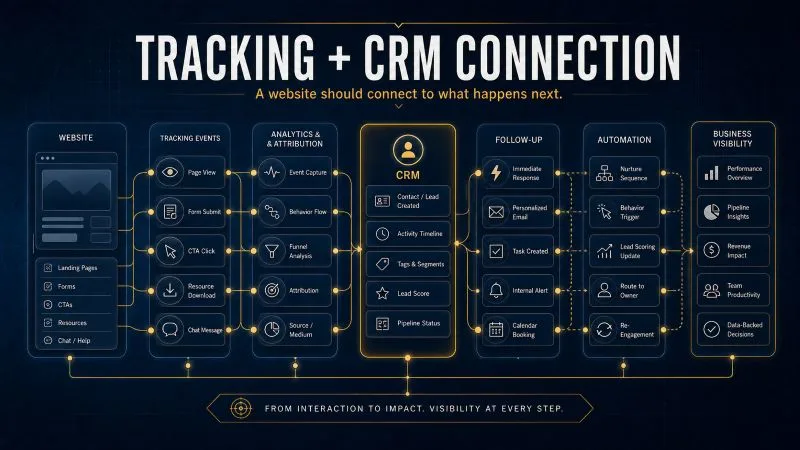
For a service-based business, the website should help connect:
Search visibility → service clarity → trust → CTA → inquiry → tracking → CRM → follow-up
That is why a serious rebuild should not start with visual design alone.
It should start with the business system.
The website is not the whole business.
But it is often the front door to the business.
If that front door is unclear, untracked, disconnected, or difficult to act on, the rest of the growth system suffers.
How to Apply This to Your Own Website
Use this quick self-check before you redesign, spend more on ads, or add another tool.
1. Is Your Homepage Clear?
Ask:
- Can a visitor understand what you do within a few seconds?
- Is it clear who you serve?
- Is the main CTA visible above the fold?
- Does the homepage guide people toward the next step?
If not, your homepage may need strategic restructuring before visual redesign.
2. Are Your Services Easy to Understand?
Ask:
- Does each core service have its own page?
- Does each service page explain the problem?
- Does the page show who the service is for?
- Does it explain the process?
- Does it include FAQ, trust signals, and CTA?
If not, your service pages may be too thin to support SEO or conversion.
3. Do Your CTAs Guide People to the Next Step?
Ask:
- Is there one primary CTA on each important page?
- Is the CTA specific?
- Does it match visitor intent?
- Are secondary CTAs useful, or are they creating confusion?
If not, visitors may be interested but unsure what to do next.
4. Is Your SEO Structure Supporting the Right Intent?
Ask:
- Does each important page target one clear search theme?
- Are your headings organized clearly?
- Are internal links helping visitors move through the site?
- Does content connect to real offers?
If not, you may be creating traffic without a clear business path.
5. Can You Track What Happens After People Click, Call, Submit, or Book?
Ask:
- Are form submissions tracked?
- Are phone clicks tracked?
- Are booking CTA clicks tracked?
- Are thank-you pages set up correctly?
- Are UTMs captured?
- Can you connect leads back to source?
If not, you may not know which marketing activities are actually producing opportunities.
6. Do New Leads Enter a Follow-Up System?
Ask:
- Do leads enter a CRM?
- Are they tagged by source or offer?
- Does someone get notified quickly?
- Is there an automated confirmation?
- Is there a follow-up process if they do not book?
If not, your website may be generating interest that never turns into a real conversation.
When to Book a Website Growth System Audit
You should consider booking a Website Growth System Audit if:
- Your website looks okay, but does not generate enough qualified inquiries
- You are planning a redesign and want strategy before design
- Your SEO traffic does not clearly turn into leads
- Your CTAs feel unclear or inconsistent
- Your service pages feel thin or scattered
- Your tracking setup does not show meaningful business actions
- Your form, booking, CRM, and follow-up systems feel disconnected
- You are not sure what to fix first
- You want a practical diagnosis before spending more on content, ads, or software
The audit is not a generic website review.
It is a growth system diagnosis.
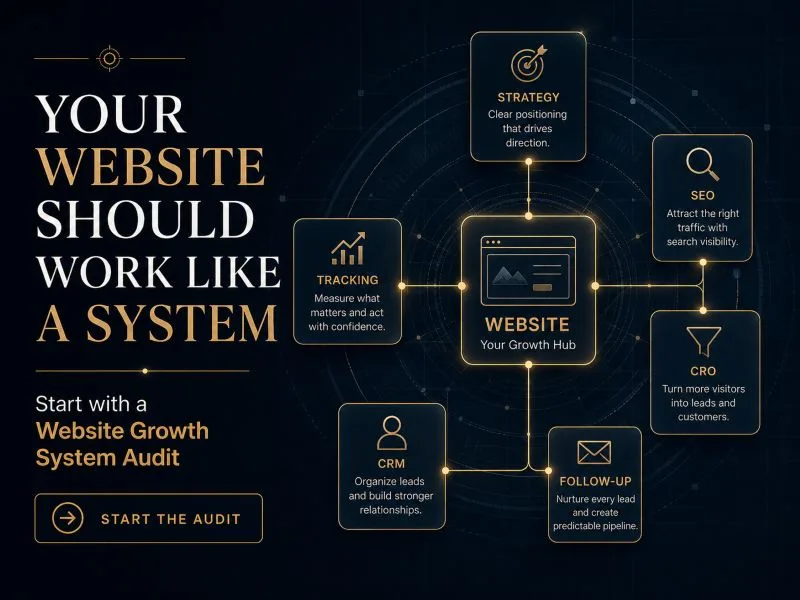
It looks at the connection between your website, SEO, CRO, tracking, CRM, booking path, and follow-up.
Your Website Should Be More Than a Digital Brochure
If your website looks fine but still does not produce enough clear inquiries, the issue may not be design alone.
It may be a system problem.
Before you redesign again, publish more content, or spend more on traffic, diagnose the path from visitor to inquiry.
Primary CTA: Book a Website Growth System Audit
Secondary CTA: Download the Website Growth System Checklist
FAQ Section
What is the difference between a website redesign and a website rebuild?
A website redesign usually focuses on how the website looks.
A website rebuild looks deeper at how the website works. That includes structure, messaging, SEO, CRO, tracking, CRM connection, booking flow, and follow-up.
A redesign can improve appearance. A rebuild should improve clarity, conversion path, and system readiness.
How long does a website rebuild usually take?
It depends on the size of the website, the complexity of the services, the content needed, and whether tracking, CRM, and booking systems are involved.
A focused rebuild can happen quickly when the scope is clear. Larger projects may need more time, especially if service pages, SEO content, tracking setup, and CRM workflows need to be rebuilt together.
The key is not only speed. The key is building in the right order.
Should SEO be planned before or after the redesign?
SEO should be planned before the redesign.
If SEO is added after the design, the site structure may not support the right search intent. Important service pages may be missing, headings may be unclear, and internal links may not guide visitors properly.
A strategy-led rebuild should plan SEO, content structure, and conversion paths before final design.
What should a service business fix first on its website?
Start with clarity.
Before changing colors or layouts, check:
– Is the main offer clear?
– Are service pages easy to understand?
– Is the CTA obvious?
– Does the page match search intent?
– Can visitors trust the business?
– Can you track inquiries?
– Does follow-up happen after the lead comes in?
If those pieces are unclear, design updates alone may not solve the problem.
How do I know if my website needs a growth system audit?
You may need a Website Growth System Audit if your website looks fine but does not create enough qualified inquiries, if tracking is unclear, if your CRM and follow-up are disconnected, or if you are not sure what to fix first.
The audit helps identify whether the issue is strategy, structure, SEO, CRO, tracking, CRM, booking, follow-up, or a combination of several parts.
